The Problem: Security as an Afterthought
Most MSPs know they should be doing more security. They add endpoint protection to their stack, maybe throw in a SIEM, and bundle it into the top tier of their package. Then a client gets breached, or a prospect asks about SOC 2, and everyone scrambles.
That’s not a security practice. That’s reactive IT support with a firewall sticker on it.
The MSPs pulling ahead right now are the ones who’ve figured out that security — specifically vCISO-level security leadership — is a recurring revenue product, not an emergency service. They’ve stopped treating compliance and governance as one-off projects and started delivering them as structured monthly engagements with predictable deliverables, defined scope, and real margin.
This guide covers how to get there.
Why vCISO Services Make Sense for MSPs
Before getting into the mechanics, it’s worth being clear about why vCISO services are a natural fit for MSPs — and why most haven’t cracked it yet.
The fit: MSPs already have client relationships, existing access to infrastructure, and some security tooling. Adding vCISO as a layer means you’re selling strategy and governance to people who already trust you. That’s a much easier sell than a cold vCISO engagement from a boutique consultancy.
The problem: vCISO delivery has traditionally been people-heavy. You’d need a senior security consultant running each account — reviewing policies, running risk assessments, preparing board reports, managing audit prep. At that cost structure, the margin is thin and scaling is painful.
That’s changing. AI-driven GRC platforms can now handle a significant portion of that work — evidence collection, gap analysis, framework mapping, risk scoring — which means an MSP with one strong security consultant can run five to ten vCISO engagements simultaneously without burning out or cutting corners.
The MSPs who get this right will own their market. Those still treating security as a line item will lose clients to the ones who do.
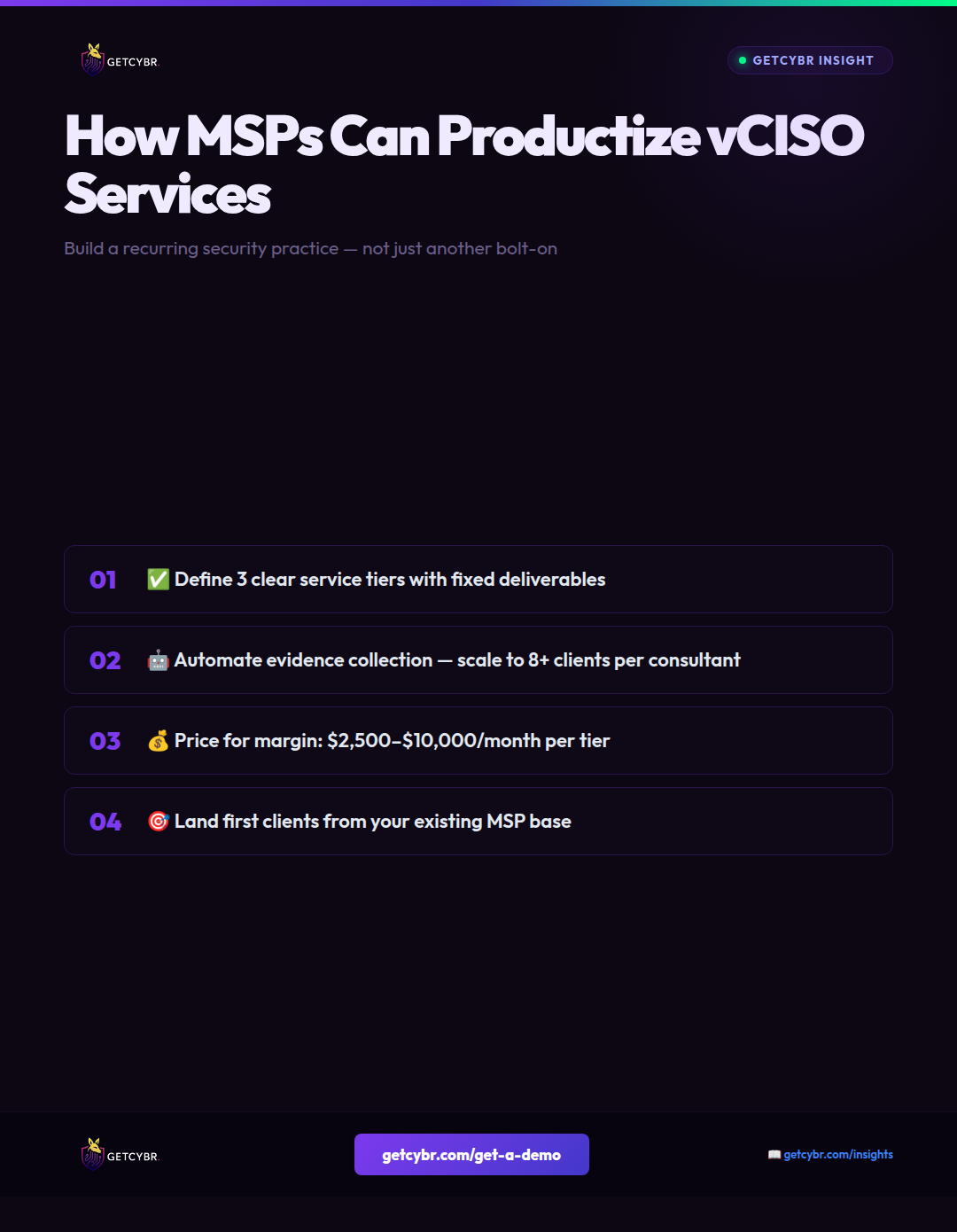
Step 1: Define What You’re Actually Selling
Most MSPs struggle with productization because they try to offer “whatever the client needs.” That’s a project, not a product.
Start by defining three tiers. Here’s a rough structure that works:
Tier 1 — Security Foundations ($500–$1,500/month)
This is entry-level governance for SMBs who know they need to do something but aren’t under audit pressure yet.
What’s included:
- Annual risk assessment (proper one, not a checkbox exercise)
- Core policy library — 10–15 policies covering acceptable use, incident response, access control, etc.
- Quarterly security review call
- Vulnerability scan + basic remediation tracking
- Staff security awareness training (phishing sim + annual training)
What’s not included: audit prep, framework compliance, board reporting, incident response leadership.
Tier 2 — Compliance-Ready ($2,000–$4,000/month)
For clients working toward a compliance certification — SOC 2, ISO 27001, Cyber Essentials Plus, NIST CSF — or those with contractual requirements from enterprise customers.
What’s included:
- Everything in Tier 1
- Framework gap assessment against their target compliance standard
- Evidence collection and management (ongoing)
- Quarterly compliance reviews with written summary
- Audit support and coordination
- Basic vendor risk assessments (5–10 per year)
- Monthly security metrics report
What’s not included: board-level reporting, M&A due diligence, IR retainer.
Tier 3 — Full vCISO ($5,000–$10,000/month)
For companies with regulatory exposure, enterprise clients, or Series A+ startups who need a real security leadership function without the full-time hire.
What’s included:
- Everything in Tiers 1 and 2
- Named vCISO with dedicated hours (typically 20–40 hours/month)
- Board/executive reporting
- Security roadmap and budget planning
- Third-party vendor risk management (full program)
- Incident response leadership
- M&A security due diligence on request
- Custom framework coverage across 50+ standards
The pricing ranges above are rough — your market and your team’s experience will shift them. But the structure matters: clear tiers, defined scope, no ambiguity about what’s included.
Step 2: Build the Delivery Machine
Tiers are the easy part. The hard part is delivering them consistently, at margin, across multiple clients.
Here’s where most MSP security practices fall apart: they underprice Tier 1 and Tier 2 thinking they’ll upsell to Tier 3, then discover that even “basic” vCISO work is time-consuming to do well. A policy review that looks like two hours of work turns into eight when you factor in client Q&A, revision cycles, and documentation.
The solution is to standardize ruthlessly and automate what you can.
Standardize your policy library
Don’t write policies from scratch for every client. Build a master library with fillable placeholders — company name, data classification tiers, key contacts. A well-built policy library pays for itself in the first month and gets reused across every engagement.
Build a risk assessment template that actually works
Most free risk assessment templates are garbage — too generic, too long, and not connected to anything actionable. Build one that produces a risk register your clients can actually act on. Score by likelihood and impact, map to controls, assign owners and deadlines. That risk register becomes the backbone of every quarterly review.
Use a GRC platform to run evidence collection
Manual evidence collection is where vCISO engagements die. Asking clients to screenshot their MFA settings or export their patch logs every quarter is painful for everyone. A proper vCISO platform integrates with their tech stack — Microsoft 365, AWS, Google Workspace — and pulls evidence automatically. That’s the difference between spending 10 hours per client per quarter on evidence and spending 2.
Build a repeatable quarterly cadence
Every client should get the same structure: evidence review → gap analysis → remediation tracking → client call → written summary. Build a runbook for each phase. The goal is that a new consultant can step into any engagement and know exactly what to do.
Step 3: Price for Margin, Not for Wins
This is where MSPs consistently undersell themselves.
vCISO services command premium pricing because the risk of not having them is significant. A SOC 2 Type II failure costs clients enterprise deals. A data breach at a Tier 2 client could wipe out their business. The value you’re delivering is existential, not operational.
Price accordingly.
A common mistake: quoting Tier 2 at $1,500/month because you’re afraid to lose the deal, then realizing you’ve sold 10 hours of work per month for $150/hour — before overhead. That’s not sustainable.
The right benchmark: most boutique vCISO consultancies charge $250–$350/hour for senior security advisory. If your Tier 2 service requires 15 hours of work per month (which is realistic), that’s $3,750–$5,250 in equivalent consulting value. Price your packaged service at $2,500–$3,500 and you’re giving the client a real discount while maintaining margin.
Resist the urge to discount heavily to close. Clients who push hardest on price are usually the ones who’ll consume the most time. The economics rarely improve.
Step 4: Use AI to Scale What You Can’t Hire For
The practical constraint for most MSPs is headcount. You might have one person who’s genuinely security-savvy, and you don’t want to hire a full-time vCISO before the revenue justifies it.
This is where AI-assisted GRC tools change the math. Platforms built for vCISO delivery can now handle:
- Automated gap assessments across frameworks like SOC 2, ISO 27001, NIST CSF, and dozens more
- Continuous evidence monitoring from cloud integrations
- Risk scoring and prioritization
- Policy generation and version control
- Compliance dashboards for client reporting
That doesn’t mean you remove the human from the equation — clients are paying for judgment, not just software output. But it means one consultant can comfortably run 6–8 engagements simultaneously rather than 2–3.
The model starts to look like this: your consultant spends their time on the high-value activities — client calls, risk decisions, audit support, escalations — and the platform handles the administrative and evidence-gathering workload. At that ratio, the margins on a 10-client book of business are strong enough to fund your next hire.
Step 5: Land the First Clients
You don’t need a full marketing engine to launch a vCISO practice. You need three things: a clear offer, proof of delivery, and existing relationships.
Start with your current MSP client base. Audit who has compliance requirements — contractual, regulatory, or driven by enterprise customer demands. Those are your first conversations. You’re not pitching security in the abstract; you’re offering to solve a specific problem they already know they have.
The pitch is simple: “We’ve built a structured vCISO service that handles your ongoing compliance and security governance. It’s a fixed monthly fee, you know exactly what you get, and it means you don’t have to hire a CISO or manage consultants ad-hoc.”
For clients without an obvious compliance driver, lead with the risk assessment. Offer a standalone assessment at a fixed price (or fold it into a trial month). Once they see what proper risk visibility looks like, the conversation about ongoing governance becomes much easier.
Once you have 3–5 clients at Tier 2 or above, the economics of your first dedicated security hire start to make sense. That’s your growth engine.
The Compliance Requirement Is Coming Anyway
Here’s the bigger picture: the compliance pressure on SMBs is increasing, not decreasing. Cyber insurance underwriters are raising requirements. Enterprise procurement teams are sending longer security questionnaires. Regulations like NIS2 in Europe are pulling mid-market companies into formal compliance obligations.
Your MSP clients will face these requirements whether you help them or not. If you don’t have a vCISO offering, they’ll go find one — and some of them won’t come back.
The MSPs who build this practice now will be the ones their clients call first when those requirements land. That’s a defensible position in a market where differentiation is hard.
Ready to Build Your Security Practice?
GetCybr gives MSPs the platform to deliver vCISO services at scale — automated evidence collection, multi-framework compliance, client dashboards, and risk reporting built for recurring engagements.
Book a demo to see how it works →
We’ll show you exactly how the platform fits into your delivery model and what a 10-client book of business looks like on it.
Get More Security Insights
Join security practitioners who receive our weekly compliance and security newsletter.
Further Reading
Ready to Scale Your vCISO Practice?
See how GetCybr helps MSPs deliver enterprise-grade security services.